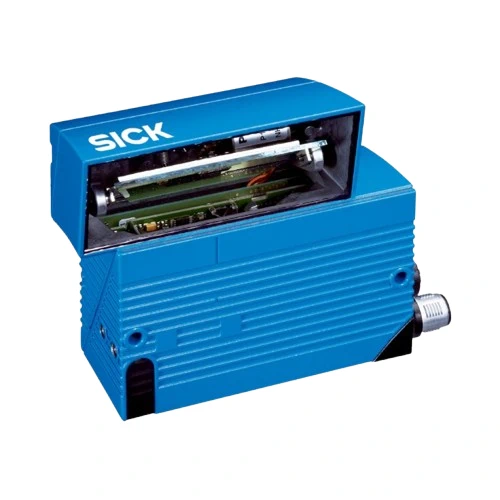
SICK 1042125 CLV650-6120 Autofocus 1D Barcode Scanner

SICK 1042125 CLV650-6120 Autofocus 1D Barcode Scanner

$500.00

CLV650-6120 reads 1D barcodes with autofocus, an oscillating mirror, 600–1,000 Hz scanning, Ethernet TCP/IP and resolution-dependent 125–1,570 mm range.

SKU: SICK-1042125 Category:
SICK Fixed Mount Barcode Scanners

SICK CLV650-6120 Oscillating-Mirror Barcode Scanner

BrandSICK
Model IdentifierCLV650-6120
Official Part Number1042125

Technical Overview

The SICK CLV650-6120 is a Standard Density laser scanner for printed 1D barcodes, combining autofocus with an oscillating mirror. Its 125–1,570 mm reading range depends on code resolution and the reading-field diagram; supported resolution spans 0.25–1 mm. Scanning runs at 600–1,000 Hz, while the mirror offers fixed, oscillating and one-shot functions with ±20° deflection. Ethernet TCP/IP supports result output and service access, alongside the documented serial and fieldbus interfaces. A swivel connector carries one M12 twelve-pin male and one four-pin female connection. The 18–30 V DC device consumes 9.5 W and uses an IP65 die-cast aluminum housing with glass window, six status LEDs and a reading-rate bar graph.

Autofocus 1D barcode scanner with oscillating mirror, 600–1,000 Hz scanning, resolution-dependent 125–1,570 mm range and Ethernet TCP/IP.

Key Features

  • Standard Density laser-based reading of printed 1D barcodes
  • Autofocus; oscillating-mirror reading field
  • 125–1,570 mm reading range, dependent on code resolution and reading field
  • 0.25–1 mm code resolution; 600–1,000 Hz scanning
  • Fixed, oscillating and one-shot mirror modes; 0.5–6.25 Hz oscillation; ±20° deflection
  • Ethernet TCP/IP for result output and service; 10/100 Mbit/s
  • Standard decoder: 1–20 codes per scan; SMART decoder: 1–6
  • Two M12 connections on swivel unit: twelve-pin male and four-pin female
  • 18–30 V DC; 9.5 W; SOPAS ET configuration
  • IP65 die-cast aluminum housing; glass window; 0 to +40 °C operation

Read printed 1D labels across a commissioned autofocus and mirror-scan field, then send decoded identifiers to external tracking or inspection software.

Technical Specification Matrix

ParameterValue
Product typeFixed-mount 1D barcode scanner; Standard Density
Reading technologyLaser-based; printed labels
Reading fieldOscillating mirror
Optical focusAutofocus
Light sourceVisible red laser, 658 nm
Laser class2; EN 60825-1:2014+A11:2021 and IEC 60825-1:2014
Aperture angle≤50°
Reading distance125–1,570 mm, dependent on code resolution and reading-field diagram
Code resolution0.25–1 mm
Scanning frequency600–1,000 Hz
Mirror functionsFixed with adjustable position; oscillating with variable or fixed amplitude; one shot
Oscillation frequency0.5–6.25 Hz
Mirror deflection−20 to +20°
Barcode typesCode 39; Code 128; Code 93; Codabar; GS1-128/EAN 128; UPC/GTIN/EAN; Interleaved 2 of 5; Pharmacode; GS1 DataBar; Telepen; MSI/Plessey
Print ratio2:1 to 3:1
Codes per scan1–20 with standard decoder; 1–6 with SMART decoder
Codes per reading interval1–50, auto-discriminating
Characters per reading interval5,000; 500 for CAN multiplexer function
Multiple readings1–99
EthernetTCP/IP, 10/100 Mbit/s; read-result output and service
PROFINET10/100 Mbit/s; single port; dual port optional through external CDF600-2 module
EtherNet/IP10/100 Mbit/s
EtherCATOptional through external CDF600 fieldbus module
Serial interfacesRS-232, RS-422 and RS-485; read-result output and service; 2,400 baud to 115.2 kbaud; AUX RS-232 at 57.6 kbaud
CANSICK CAN sensor network CSN, controller/device and multiplexer/server; 20 kbit/s to 1 Mbit/s
CANopen20 kbit/s to 1 Mbit/s
PROFIBUS DPOptional through external CDF600-2 fieldbus module
Digital inputsSensor 1 input; two further inputs through optional CMC600 parameter memory in CDB620/CDM420
Digital outputsTwo through optional CMC600 parameter memory in CDB620/CDM420
Reading pulse sourcesDigital inputs; non-powered; serial interface; auto pulse; CAN
Optical indicationSix status LEDs; ten-LED bar graph displays reading-rate percentage
Acoustic indicationBeeper/buzzer; can be switched off or assigned as result indication
ControlsTwo buttons to choose and start/stop functions
Configuration softwareSOPAS ET
Memory cardOptional microSD flash card
ConnectionSwivel unit with one M12 twelve-pin male connector and one M12 four-pin female connector
Connector codingTwelve-pin male A-coded; four-pin female D-coded
MountingTwo M5 blind threaded holes, 5 mm deep
Power supply18–30 V DC
Power consumption9.5 W
Housing materialAluminum die cast
Housing colorLight blue, RAL 5012
Window materialGlass
IP ratingIP65, EN 60529
Protection classIII, EN 61140
MTBF100,000 h
Laser-diode MTTF40,000 h at +25 °C
EMCEN 61000-6-3 (2001-10) and EN 61000-6-2:2005
Vibration resistanceEN 60068-2-6 (1995)
Shock resistanceEN 60068-2-27 (1993)
Operating temperature0 to +40 °C
Storage temperature−20 to +70 °C
Relative humidity90%, non-condensing
Ambient light immunity2,000 lx on barcode
Barcode print contrastPCS ≥60%
Physical Weight (kg)0.25

Industrial Applications

1. Associating cartons with conveyor tracking records

A conveyor can present printed 1D carton labels within a commissioned reading field and transmit decoded identifiers to external tracking software over Ethernet TCP/IP. Autofocus accommodates qualified changes in label distance, while oscillating-mirror setup addresses the installed label presentation. Commissioning checks code resolution, print contrast and transit timing against the actual reading-field diagram and scanning settings.

Problem Solved

A decoded carton identifier gives external tracking software a reference for associating the passing load with its handling record, supporting routing and traceability at the monitored station.

Carton tracking Autofocus Ethernet results

2. Checking a component label against the scheduled assembly

An assembly fixture can present a printed component barcode to the scanner before an ordinary production step. External inspection software receives the decoded 1D value and compares it with the scheduled component record. The installation establishes a stable reading field, validates the selected symbology and uses the configured reading interval to associate the result with the presented part.

Problem Solved

A decoded component value supports an external comparison with the scheduled assembly record, helping identify a label mismatch before the next ordinary production operation proceeds.

Component verification 1D identifier External comparison

3. Collecting several identifiers during one reading interval

A package inspection station can present several printed 1D labels and collect their decoded values during one configured reading interval. The scanner supports one to fifty codes per interval, with per-scan limits dependent on standard or SMART decoding. External software associates the collected identifiers with the inspected package after commissioning verifies label spacing, readable field coverage, code resolution and expected result count.

Problem Solved

Multiple decoded identifiers provide external package software with a set of label values to compare against an expected manifest, supporting completeness and association checks for the presented package.

Multiple identifiers Package inspection Reading interval