1. Reciprocating Part-Transfer Cylinder
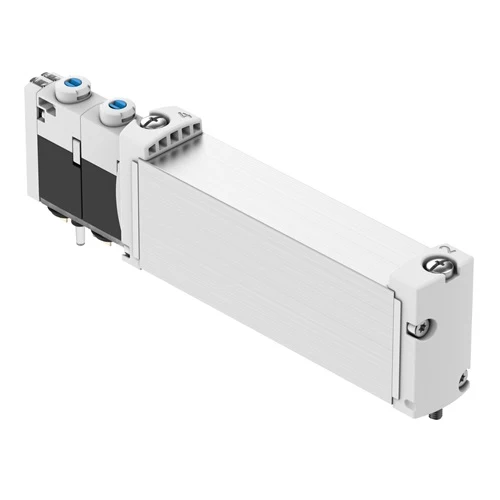
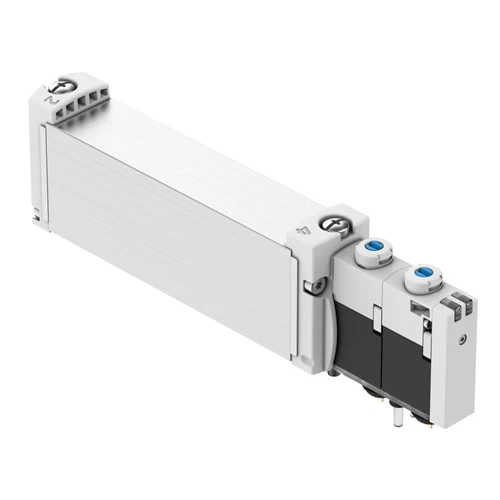
An assembly machine uses a double-acting cylinder to transfer a component between two positions. The 5/2-way valve alternates pressure and exhaust between the working lines through a flange interface. Its 18 mm size and manifold-rail mounting support a grouped pneumatic control assembly, while the E-box provides the electrical connection and LEDs show the signal state during commissioning.
Problem Solved
Directional switching supplies the two pneumatic states needed for cylinder extension and retraction, while flange and manifold mounting group the transfer circuit with adjacent valve functions.
5/2-way
Flange interface
18 mm valve
2. Pneumatic Gripper Open-and-Close Sequencing
A handling unit uses a double-acting gripper whose working pressure is set separately from the valve actuation supply. External pilot air at 1.5–8 bar operates the double-solenoid 5/2-way valve independently of the working circuit. This arrangement supports a gripper circuit in which directional control remains supplied by a separate pilot-air connection.
Problem Solved
Separating pilot air from working pressure allows the valve actuation supply and gripper pressure circuit to be arranged independently, while electrical commands select the directional state.
External pilot
1.5–8 bar pilot
Double solenoid
3. Two-Position Product Diverter Actuation
A packaging conveyor uses a pneumatic actuator to move a product diverter between two routes. The valve reverses the actuator air connections through its 5/2-way circuit, with a 15 ms specified reversal time. The maximum switching frequency of 3 Hz provides a concrete valve limit for planning directional commands alongside the actuator and load response.
Problem Solved
Documented reversal timing and switching frequency support planning the diverter commands, while the 5/2-way valve supplies the directional air routing required by the actuator.
15 ms reversal
3 Hz maximum
1000 l/min nominal