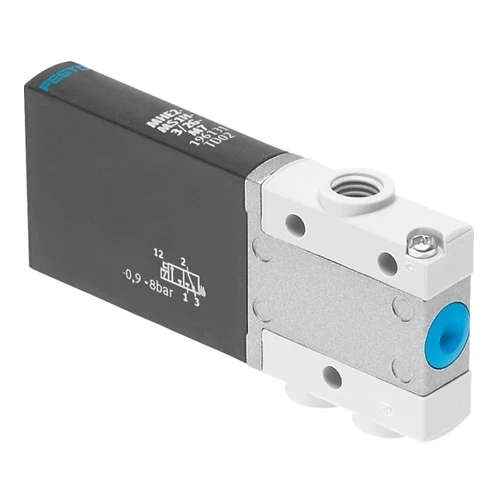
1. Timed Interruption of a Pneumatic Air Line
A production station needs to interrupt an otherwise open pneumatic working line under electrical command. The valve's normally open 3/2 function provides the appropriate unenergized flow state, with mechanical spring reset after the command is removed. Its 7 ms on and 3.5 ms off component times, 100 l/min nominal flow and 130 Hz maximum switching frequency characterize the selected switching element without guaranteeing the complete line response.
Problem Solved
The normally open directional function provides an electrical means of changing the working-line state, with documented switching times and flow capacity for evaluating the commanded interruption.
7 ms on / 3.5 ms off
130 Hz maximum
100 l/min
2. Energize-to-Vent Single-Acting Actuator Circuit
A fixture uses a single-acting pneumatic actuator whose circuit requires pressure in the valve's unenergized state and venting under an electrical command. The normally open 3/2 function supplies this directional arrangement, while mechanical spring reset restores the valve's normal state after de-energization. Its 24 V DC two-pin connection and 100% duty rating characterize the electrical interface for maintaining an energized valve command.
Problem Solved
The normally open three-port arrangement provides the pressure and vent routing states for an energize-to-vent circuit, with mechanical spring return to the documented normal valve state.
3/2 normally open
Mechanical spring
24 V DC
3. Direct Switching of a Vacuum Branch
A vacuum-handling branch needs an electrically actuated valve without relying on a separate pilot-air pressure differential. The MHE2 uses direct actuation and has a documented negative-pressure operating range down to −0.9 bar. Flow reversal is permitted only with restrictions and a separate −0.9 to 1 bar range, so the vacuum circuit arrangement must follow that documented distinction rather than treating the valve as unrestricted in either direction.
Problem Solved
Direct actuation supplies electrical switching for the negative-pressure circuit, while the explicit normal and reversed pressure ratings define the supported pneumatic arrangement of the branch.
Direct actuation
−0.9 bar capability
Restricted reversal