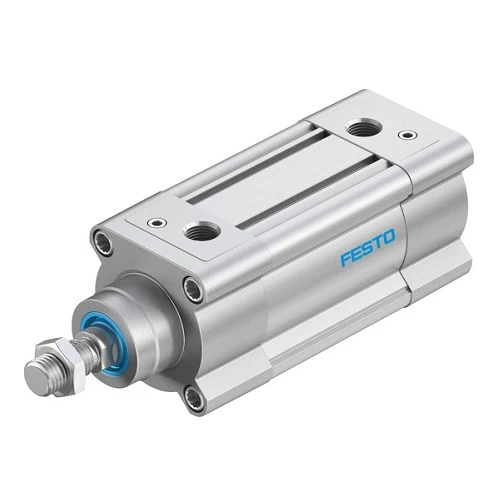
Festo 1383580 ISO Cylinder, 63 mm Bore, 50 mm Stroke

Festo 1383580 ISO Cylinder, 63 mm Bore, 50 mm Stroke

ISO 15552 cylinder with adjustable pneumatic cushioning, G3/8 ports, M16×1.5 rod thread, 1870 N theoretical advance force at 6 bar and 2050 g weight.

SKU: Festo-1383580 Category:
Festo Profile Cylinder And Tie Rod Cylinder

Festo DSBC-63-50-PPVA-N3 ISO Cylinder

BrandFesto
Model IdentifierDSBC-63-50-PPVA-N3
Official Part Number1383580

Technical Overview

The Festo DSBC-63-50-PPVA-N3 is a double-acting ISO 15552 cylinder with a 63 mm piston diameter and 50 mm stroke. Pneumatic cushioning is adjustable at both ends, with a 22 mm cushioning length and 1.3 J end-position impact-energy rating. The single-ended rod has an M16×1.5 male thread, and G3/8 ports supply the 0.4–12 bar working range. At 6 bar, theoretical forces are 1870 N advancing and 1682 N retracting. Proximity-switch position detection is documented for this 2050 g unit, which uses a smooth-anodised aluminium profile barrel and coated die-cast aluminium covers.

63 mm bore, 50 mm stroke ISO 15552 cylinder with adjustable pneumatic cushioning, G3/8 ports, M16×1.5 rod thread and 2050 g product weight.

Key Features

  • 63 mm piston diameter and 50 mm stroke
  • Conforms to ISO 15552
  • Double-acting operation with single-ended piston rod
  • Pneumatic cushioning adjustable at both ends; 22 mm cushioning length
  • 1870 N advance and 1682 N return theoretical force at 6 bar
  • M16×1.5 male rod thread and G3/8 pneumatic ports
  • Position detection via proximity switch
  • 0.4–12 bar operating pressure and −20 to +80 °C ambient range
  • 2050 g product weight with 555 g moving mass
  • Smooth-anodised aluminium profile barrel and coated die-cast aluminium covers

Provide a 50 mm double-acting stroke with ISO 15552 interfaces and adjustable pneumatic end cushioning, delivering 1870 N theoretical advance force at 6 bar.

Technical Specification Matrix

ParameterValue
Stroke50 mm
Piston diameter63 mm
Piston rod threadM16x1.5
CushioningPneumatic cushioning, adjustable at both ends
Mounting positionAny
Conforms to standardISO 15552
Piston-rod endMale thread
DesignPiston; Piston rod; Profile barrel
Position detectionVia proximity switch
VariantsPiston rod at one end
Operating pressure0.04 MPa...1.2 MPa; 0.4 bar...12 bar
Mode of operationDouble-acting
Operating mediumCompressed air to ISO 8573-1:2010 [7:4:4]
Note on operating and pilot mediumLubricated operation possible (in which case lubricated operation will; always be required)
Corrosion resistance class CRC2 - Moderate corrosion stress
LABS (PWIS) conformityVDMA24364-B1/B2-L
Ambient temperature-20 °C...80 °C
Impact energy in end positions1.3 J
Cushioning length22 mm
Theoretical force at 0.6 MPa (6 bar, 87 psi), return stroke1682 N
Theoretical force at 0.6 MPa (6 bar, 87 psi), advance stroke1870 N
Moving mass555 g
Moving mass for 0 mm stroke430 g
Additional moving mass per 10 mm stroke25 g
Physical Weight (kg)2.05
Reference mass for 0 mm stroke1740 g
Incremental mass per 10 mm stroke62 g
Type of mountingEither:; With female thread; With accessories
Pneumatic connectionG3/8
Note on materialsRoHS compliant
Material coverCoated die-cast aluminium
Material piston sealTPE-U(PU)
Material pistonWrought aluminium alloy
Material piston rodHigh-alloy steel
Material piston rod wiperTPE-U(PU)
Buffer seal materialTPE-U(PU)
Material of cushioning bossPOM
Material cylinder barrelSmooth-anodised wrought aluminium alloy
Material nutGalvanised steel
Material bearingPOM
Material collar screwsGalvanised steel

Industrial Applications

1. Powered Component Ejection and Return

An assembly fixture needs to push a released component clear of its nest and retract the attachment for the next part. The 50 mm stroke supplies the documented travel, and double-acting operation powers both directions. An M16×1.5 rod thread connects the suitable pusher attachment, while the manufacturer specifies 1870 N theoretical advance force at 6 bar for evaluating the pneumatic ejection action.

Problem Solved

Powered movement in both directions provides an advancing ejection action and a positive return stroke, with a defined stroke length and documented theoretical force for the mechanism.

50 mm stroke Double-acting 1870 N at 6 bar

2. Position-Confirmed Stop Retraction

A machine retracts a mechanical stop before continuing the assembly sequence. Proximity-switch position detection gives the controller a means of observing the cylinder position, while adjustable pneumatic cushioning acts at both ends of the 50 mm stroke. Double-acting operation provides powered return, and the G3/8 ports connect the two working lines for the stop mechanism.

Problem Solved

Proximity-switch compatibility supports position confirmation before the machine proceeds, while double-acting travel provides the pneumatic movement needed to extend and retract the stop.

Proximity-switch detection Adjustable pneumatic cushioning G3/8 ports

3. Cushioned Arrival of a Pneumatic Transfer Mechanism

A pneumatic mechanism reaches each end of a 50 mm working stroke while carrying its attachment. Adjustable pneumatic cushioning acts at both ends over a documented 22 mm cushioning length, with a 1.3 J end-position impact-energy rating. These exact component characteristics provide the basis for evaluating end arrival together with the moving load and selected pneumatic motion conditions.

Problem Solved

Adjustable pneumatic cushioning provides an end-of-stroke deceleration mechanism, with defined cushioning length and impact-energy data for evaluating arrival of the moving attachment.

Adjustable pneumatic cushioning 22 mm cushioning length 1.3 J end-position energy