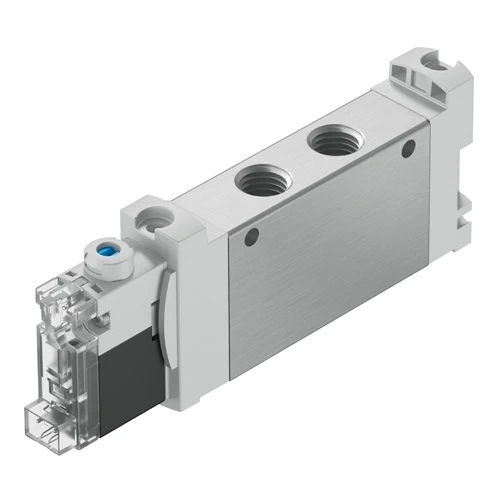
1. Reciprocating Part-Transfer Cylinder
An assembly machine uses a double-acting cylinder to transfer a component between two positions. The valve's 5/2-way function alternates pressure and exhaust between its two G1/8 working ports. One 24 V DC solenoid commands the valve, with pneumatic spring reset providing the alternate state. Its 14 mm body and manifold mounting support a grouped pneumatic control assembly.
Problem Solved
Two working ports provide the directional switching needed for extension and retraction, while compact manifold mounting keeps the transfer mechanism's pneumatic controls grouped together.
5/2-way
G1/8 working ports
14 mm valve
2. Pneumatic Gripper Open-and-Close Sequencing
A handling unit needs a solenoid command and reset state for a double-acting pneumatic gripper. This single-solenoid 5/2-way valve directs pressure and exhaust between the gripper's air lines, with pneumatic spring reset defining the alternate valve state. Its internal pilot supply uses the documented 2.5–7 bar operating range, while LED indication shows the electrical command locally.
Problem Solved
Single-solenoid routing and pneumatic spring reset provide commanded and alternate valve states for the gripper circuit, with local LED indication making the electrical actuation visible during setup.
Pneumatic spring reset
24 V DC
LED indication
3. Two-Position Product Diverter Actuation
A packaging conveyor uses a pneumatic actuator to move a product diverter between two routes. The valve selects the actuator's air connections through its 5/2-way circuit, with 14 ms switch-on and 24 ms switch-off times. The documented 2 Hz maximum switching frequency provides a component limit when planning the diverter sequence alongside the actuator and tubing response.
Problem Solved
Directional switching operates the diverter between its two routes, while specified switching times and maximum frequency provide concrete valve limits for planning the repeated command sequence.
14 ms on
24 ms off
2 Hz maximum