1. Fixture Clamp and Ejector Sequencing
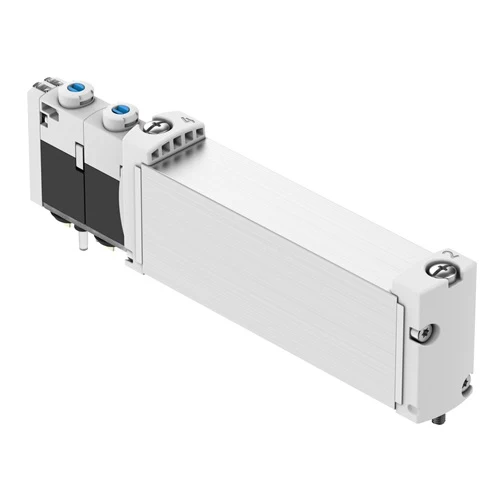
An assembly fixture uses separate single-acting clamp and ejector circuits at different points in its cycle. The dual normally closed 3/2-way functions provide two supply-and-exhaust switching paths in one 18 mm body. Pneumatic spring reset defines each alternate state, while flange working connections and an E-box electrical interface connect the valve to the fixture controls.
Problem Solved
Two monostable switching functions consolidate the clamp and ejector air commands in one compact valve, supporting separate process steps without using two individual valve bodies.
2 × 3/2-way NC
18 mm body
Flange ports
2. Two-Zone Air-Blast Commands
A packaging station directs compressed-air blasts to two separate process points, such as a part-release point and a tooling surface. Two normally closed 3/2-way functions let the machine sequence command the respective air circuits. The documented 15 ms switch-on and 37 ms switch-off times characterise valve response, with a 3 Hz maximum switching frequency providing an additional component limit.
Problem Solved
Separate normally closed air paths support two timed blast commands in one valve package, with published switching times providing a concrete basis for the pneumatic sequence.
2 pneumatic functions
15 ms on
37 ms off
3. Electrical-to-Pneumatic Pilot Signal Conversion
A machine uses pneumatic commands to actuate two downstream control functions. The dual 3/2-way valve converts 24 V DC electrical actuation into two normally closed pneumatic switching paths, with pneumatic spring reset and flange working ports. Its external pilot supply and manifold mounting support grouping these signal-conversion functions with other pneumatic controls within the 1.5–10 bar operating range.
Problem Solved
A compact dual-function valve links electrical sequence outputs to pneumatic command circuits, while pneumatic spring reset supplies a defined monostable return action for each switching path.
24 V DC
External pilot
Spring reset