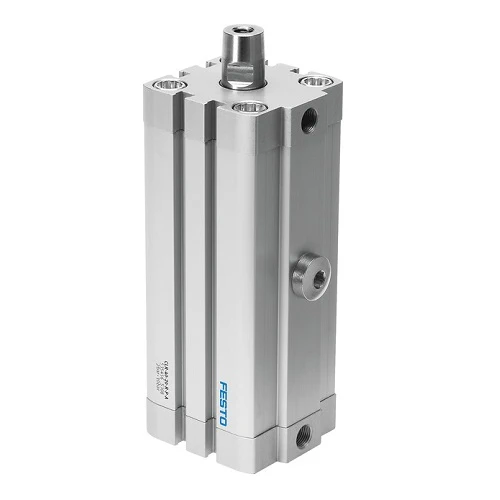
1. Fixtures Requiring Clear Loading Access
A fixture needs its clamping attachment to move away from the workpiece loading area before applying downward clamping travel. The CLR combines a 90° right-hand swivel with a 10 mm clamping stroke, rather than providing linear motion alone. Its M8 piston-rod thread gives the attachment interface, while the 28 mm total stroke describes the complete actuator movement of this exact version.
Problem Solved
Combined swivel and linear motion lets a suitable fixture attachment move between an access position and a clamping position using one pneumatic actuator with documented movement geometry.
90° right swivel
10 mm clamping stroke
M8 interface
2. Pressure-Defined Workpiece Clamping
An assembly fixture must apply a clamping action whose force can be evaluated at the available pneumatic pressure. Festo specifies effective forces of 111 N at 2 bar, 216 N at 4 bar and 313 N at 6 bar for this clamp. These effective values characterize the clamping action directly, rather than requiring the fixture designer to treat the separately listed theoretical force as delivered force.
Problem Solved
Published effective clamping forces at three pressures provide concrete force data for the fixture task, supporting a pressure-based assessment of the selected pneumatic clamping mechanism.
111 N at 2 bar
216 N at 4 bar
313 N at 6 bar
3. Position-Confirmed Automated Clamping Sequence
An automated station needs to observe clamp position before advancing the surrounding assembly sequence. This variant supports detection through proximity switches and uses double-acting pneumatic motion for movement in both directions. Elastic cushioning rings or plates act at the stroke ends, and through-hole, female-thread or accessory mounting options support integration into the fixture structure without changing the documented sensing method.
Problem Solved
Proximity-switch compatibility supplies a means of monitoring actuator position in the sequence, while double-acting operation moves the clamp through its working and return movements.
Proximity-switch detection
Double-acting
Elastic cushioning