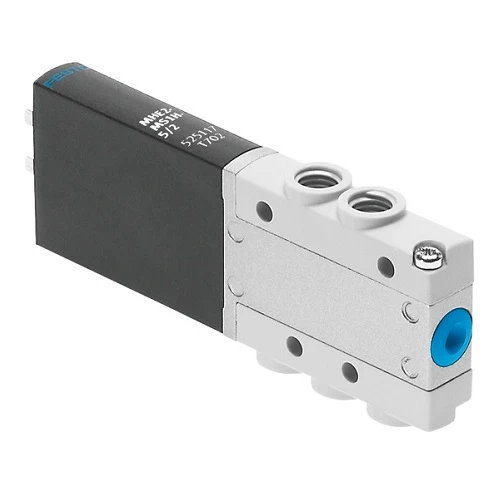
Festo 525113 Direct 5/2 Solenoid Valve, M7, 24 V DC, 90 l/min

Festo 525113 Direct 5/2 Solenoid Valve, M7, 24 V DC, 90 l/min

10 mm direct-acting spring-reset valve with M7 ports, 1.9 ms on/1.7 ms off timing, holding-current reduction, two-pin plug and IP65 protection.

SKU: Festo-525113 Category:
Festo Solenoid Valves

Festo MHE2-MS1H-5/2-M7 Direct-Acting Solenoid Valve

BrandFesto
Model IdentifierMHE2-MS1H-5/2-M7
Official Part Number525113

Technical Overview

The Festo MHE2-MS1H-5/2-M7 is a direct-acting, single-solenoid 5/2-way valve with mechanical spring reset and 90 l/min standard nominal flow. All five ports use M7 threads in a 10 mm-wide body with a 2 mm nominal passage. The 24 V DC coil uses holding-current reduction, with 6.5 W high-current and 1.625 W low-current phases, and connects through a two-pin plug. Specified switching times are 1.9 ms on and 1.7 ms off, with a 300 Hz maximum frequency subject to temperature restrictions. The 70 g coated die-cast zinc assembly has IP65 protection, through-hole mounting and a −0.9 to 8 bar operating range.

M7 direct-acting 5/2 valve with mechanical spring reset, 90 l/min nominal flow, 24 V DC actuation and 1.9 ms on/1.7 ms off switching.

Key Features

  • Single-solenoid 5/2-way function with mechanical spring reset
  • Direct-acting pressure-relief poppet construction; 2 mm nominal size
  • M7 connections at supply, working and exhaust ports
  • 90 l/min standard nominal flow to DIN 1343
  • 10 mm body and 14 mm mounting grid; 4 mm minimum inter-valve spacing
  • −0.9 to 8 bar operating range; non-reversible flow
  • 1.9 ms on and 1.7 ms off switching, with +10%/−30% tolerances
  • 300 Hz maximum switching frequency, subject to frequency-dependent temperature limits
  • 24 V DC two-pin plug; 6.5 W high-current/1.625 W low-current coil phases
  • 70 g coated zinc body, IP65, holding-current reduction and non-detenting manual override

Switch a five-port M7 circuit directly from 24 V DC with 1.9 ms on/1.7 ms off component timing in a 10 mm valve body.

Technical Specification Matrix

ParameterValue
Valve function5/2-way, single solenoid
Type of actuationElectrical
Construction width10 mm
Standard nominal flow rate (standardised to DIN 1343)90 l/min
pneumatic working portM7
Operating voltage24 V DC
Operating pressure-0.09 MPa...0.8 MPa; -0.9 bar...8 bar; -13.05 psi...116 psi
DesignPressure relief poppet valve
Type of resetMechanical spring
Degree of protectionIP65
ApprovalRCM; c UL us - Recognised (Oil)
CE mark (see declaration of conformity)To EU EMC Directive; In accordance with EU RoHS Directive
UKCA marking (see declaration of conformity)To UK instructions for EMC; To UK RoHS instructions
Nominal size2 mm
Mounting grid pitch14 mm
Minimum inter-valve spacingMinimum distance between the valves is 4 mm
Exhaust-air functionCan be throttled
Sealing principleSoft
Mounting positionAny
Manual overrideNon-detenting
Type of pilotingDirect
Flow directionNon-reversible
lapUnderlap
Reverse polarity protectionBipolar
Additional functionsSpark arresting; Holding current reduction; Protective circuit
Max. switching frequency300 Hz
Switching time off1.7 ms
Switching time on1.9 ms
Tolerance switching time off+10%/-30%
Tolerance switching time on+10%/-30%
Switching time dispersion from 1 Hz0.2 ms
Duty cycle100%
Characteristic coil data24 V DC: low-current phase 1.625 W, high-current phase 6.5 W
Permissible voltage fluctuations+/-10%
Operating mediumCompressed air to ISO 8573-1:2010 [7:4:4]
Note on operating and pilot mediumLubricated operation possible (in which case lubricated operation will; always be required)
Vibration resistanceTransport application test with severity level 2 to FN 942017-4 and EN; 60068-2-6
Restrictions for environmental and media temperatureAs a function of switching frequency (see graph)
Shock resistanceShock test with severity level 2 to FN 942017-5 and EN 60068-2-27
Corrosion resistance class CRC2 - Moderate corrosion stress
LABS (PWIS) conformityVDMA24364-B1/B2-L
Cleanroom suitability, measured according to ISO 14644-14Class 6 according to ISO 14644-1
Media temperature-5 °C...60 °C
Ambient temperature-5 °C...60 °C
Max. tightening torque for fitting2 Nm
Physical Weight (kg)0.07
Electrical connection2-pin; Plug
Type of mountingWith through-hole
Pneumatic connection, port 1M7
Pneumatic connection, port 2M7
Pneumatic connection, port 3M7
Pneumatic connection, port 4M7
Pneumatic connection, port 5M7
Note on materialsRoHS compliant
Material sealsHNBR; NBR
Material housingDie-cast zinc, coated
Material screwsGalvanised steel

Industrial Applications

1. Double-Acting Cylinder Direction Control

A transfer fixture needs to alternate pressure and exhaust between the two chambers of a double-acting cylinder. The valve's single-solenoid 5/2 function provides the two routing states, with mechanical spring reset. M7 connections and 90 l/min standard nominal flow define the pneumatic interface, while a two-pin plug provides the 24 V DC electrical actuation interface.

Problem Solved

The five-port routing function supplies the cylinder's directional pressure and exhaust paths, combining an electrical command and mechanical spring reset for the fixture's pneumatic sequence.

5/2 single solenoid Mechanical spring reset M7 ports

2. Exhaust-Flow Setup for a Pneumatic Mechanism

A pneumatic mechanism needs its exhaust path arranged to suit the intended motion behaviour. Festo specifies that this valve's exhaust can be throttled, allowing appropriate external flow-control components in the surrounding circuit. The −0.9 to 8 bar working range and non-reversible flow direction define the valve conditions, while the actuator load and installed restriction determine the resulting motion.

Problem Solved

Throttleable exhaust permits flow-control elements to shape the connected mechanism's exhaust behaviour, providing a defined routing component for tuning the pneumatic motion in its intended flow direction.

Throttleable exhaust −0.9 to 8 bar Non-reversible flow

3. Local Routing Checks during Commissioning

During machine commissioning, a technician needs to exercise the valve's pneumatic routing at the component before completing the sequence setup. The non-detenting manual override provides local actuation, while through-hole mounting locates the body in the assembly. Separate 1.9 ms on and 1.7 ms off specifications characterise component switching for the subsequent electrical sequence.

Problem Solved

A local manual override lets the technician exercise the valve routing during setup, while the documented mounting and switching data support integration into the machine's pneumatic sequence.

Non-detenting override 1.9 ms on / 1.7 ms off Through-hole mounting