1. Embedded Defect Classification
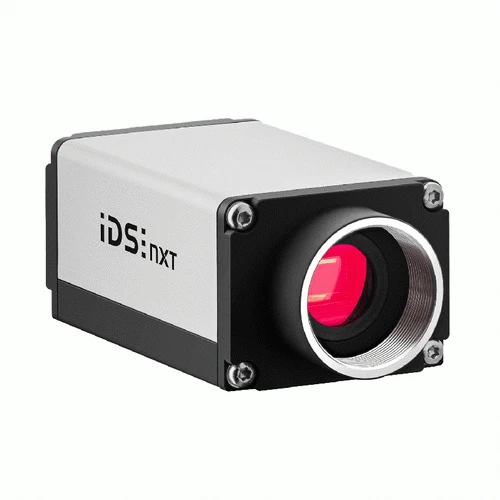
A machine builder configures a camera station to classify visible defects on a moving web or component without sending every frame to a separate vision computer. The IDS NXT rio pairs its 5.01 MP global-shutter sensor with an embedded Xilinx Zynq UltraScale+ platform for configured image-analysis workloads. GigE RJ45 connects the camera into the machine network.
Problem Solved
The embedded SoC provides the documented on-camera processing platform for configured AI workloads, while the global-shutter sensor captures monochrome image data. This architecture supports running the selected vision function in the camera node.
Embedded AI
Global shutter
GigE
2. Triggered Part Recognition
A fixture station requests an image when a component reaches a defined inspection position. The camera supports a global shutter and optocoupled trigger input through its 12-pin M12 connector, with up to 25 fps maximum trigger mode. The embedded processor can run the configured recognition task, and GigE connects the node to plant systems.
Problem Solved
The optocoupled trigger input synchronizes camera acquisition with the fixture event, while the global shutter captures the scene at one exposure interval. The on-camera SoC can execute the configured recognition workload.
25 fps trigger
Optocoupled I/O
On-camera AI
3. Networked Vision with Process I/O
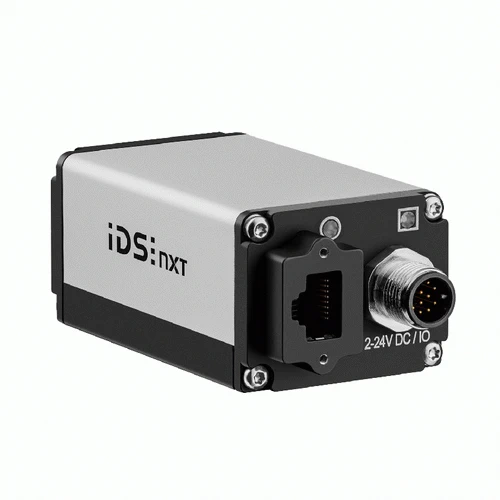
A production cell needs a vision node that exchanges images and process signals with machine controls. The camera combines GigE with a 12-pin M12 interface providing optocoupled inputs and outputs, flash and RS-232. A C-mount lens and 12–24 V or PoE supply allow the integrator to configure the imaging station around its process requirements.
Problem Solved
The M12 connector consolidates documented trigger, optocoupled I/O, flash and serial signals at the camera, while GigE provides the network path. This supports wiring the vision node into a coordinated machine-control design.
12-pin M12
GigE
PoE