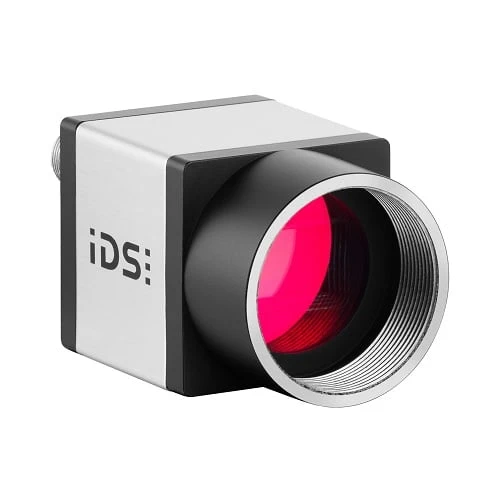
IDS AB10914 UI-5130CP-M-GL Rev.2.2 205 fps GigE Camera

Capture 800 × 600-pixel monochrome images with an onsemi PYTHON 500 global-shutter sensor, 4.8 µm pixels, GigE Ethernet, 128 MB memory and PoE.

SKU: IDS-AB10914 Category:
IDS CP Cameras

IDS UI-5130CP-M-GL Rev.2.2 0.48 MP Monochrome GigE Camera

BrandIDS
Model IdentifierUI-5130CP-M-GL Rev.2.2
Official Part NumberAB10914

Technical Overview

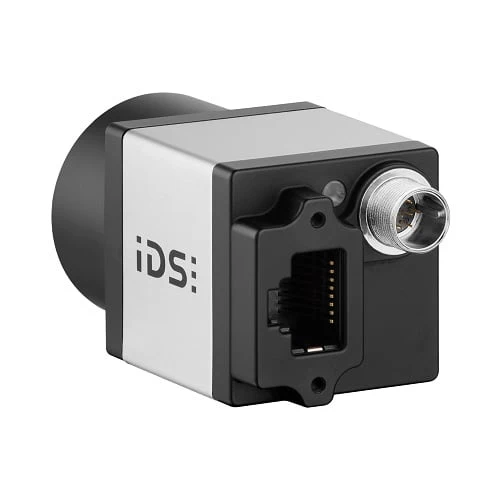
The IDS UI-5130CP-M-GL Rev.2.2 is a monochrome GigE camera using the onsemi NOIP1SN0500A-QDI PYTHON 500 global-shutter CMOS sensor. Its 800 × 600-pixel image supports 205 fps acquisition, recording component geometry within a common exposure interval for host inspection. Horizontal and vertical area selection can increase the image reading rate, and hardware-triggered acquisition requests capture at the selected inspection step. The C-mount camera combines 128 MB image memory with optocoupled trigger and flash connections on an eight-pin Hirose connector, plus a screwable RJ45 Ethernet interface and 12–24 V DC or PoE power for integration.

0.48 MP monochrome global-shutter GigE camera with onsemi NOIP1SN0500A-QDI, 800 × 600 pixels, 205 fps acquisition and PoE.

Key Features

  • onsemi NOIP1SN0500A-QDI monochrome PYTHON 500 CMOS sensor
  • 800 × 600 pixels; 4.8 µm pixel size
  • Global shutter; 205 fps freerun and triggered acquisition
  • 10-bit ADC; 12-bit camera output
  • GigE Ethernet, 1.00 Gbps and screwable RJ45 connector
  • Hardware-triggered acquisition, region selection and Multi-AOI
  • C-mount lens interface
  • 8-pin Hirose connector with optocoupled trigger and flash signals
  • 128 MB image memory; 12–24 V DC or PoE power
  • Magnesium/stainless-steel housing; IP30

Record 800 × 600-pixel images at 205 fps with global exposure to preserve component geometry for host inspection.

Technical Specification Matrix

ParameterValue
Sensor manufactureronsemi
Sensor modelNOIP1SN0500A-QDI
Sensor typeCMOS monochrome; PYTHON 500
ShutterGlobal shutter
Resolution0.48 MP; 800 × 600 pixels
Optical sensor class1/3.6-inch
Optical sensor area3.840 × 2.880 mm
Pixel size4.8 µm
Frame rate at maximum resolution205 fps
InterfaceGigE Ethernet
Interface bandwidth1.00 Gbps
Image memory128 MB
Power over EthernetSupported
IP ratingIP30
Specification measurement environmentIDS Software Suite
Sensor characteristicLinear
Aspect ratio4:3
ADC10 bit
Camera color depth12 bit
Optical sensor diagonal4.8 mm
Gain, master / RGB4× / 4×
Horizontal AOIIncreased frame rate
Vertical AOIIncreased frame rate
AOI width minimum / step120 / 8 pixels
AOI height minimum / step2 / 2 pixels
AOI position grid, horizontal / vertical8 / 2 pixels
Sensor binningFactor 2; horizontal and vertical mean; same frame rate
Sensor decimation(2,4) × (2,4)
Pixel clock range120–152 MHz
Frame rate, freerun205 fps
Frame rate, continuous trigger205 fps
Frame rate, maximum trigger205 fps
Exposure time0.058–303 ms
Long exposure, maximum5000 ms
Power consumption1.8–2.9 W
Power supply12–24 V DC or PoE
Special featuresIDS line scan mode; overlap trigger; sensor source gain; Multi-AOI
Allowed device temperature during operation0–55 °C
Allowed device temperature during storage−20–60 °C
Relative humidity20–80%, non-condensing
Interface connectorGigE RJ45, screwable
I/O connector8-pin Hirose HR25-7TR-8PA(73)
Lens mountC-mount
Acquisition modesFreerun; hardware trigger
Image processingRegion of interest
First supported software version4.96.1
I/O pin 1Ground
I/O pin 2Optocoupled flash output negative
I/O pin 3GPIO 1
I/O pin 4Optocoupled trigger input negative
I/O pin 5Optocoupled flash output positive
I/O pin 6GPIO 2
I/O pin 7Optocoupled trigger input positive
I/O pin 812–24 V DC input
Physical Weight (kg)0.052
Dimensions L x W x H (cm)2.90 x 2.90 x 2.90
Chief ray angle1.7°
Housing materialMagnesium / stainless steel

Industrial Applications

1. Moving Component Orientation Inspection

A conveyor presents individual components before a downstream handling step, where the host compares their outline and orientation with an expected view. The camera records a 800 × 600-pixel monochrome image using global exposure, so the visible edges share the same exposure interval. Its GigE interface transfers the image data to the inspection computer for evaluating component placement.

Problem Solved

Global exposure preserves relative edge positions within each frame. Spatial sampling supplies the host with image data for comparing the component outline and orientation before the next handling step.

Global shutter 800 × 600 GigE

2. Fixtured Surface Finish Comparison

An inspection fixture presents a machined or coated part under controlled illumination to reveal local scratches and finish differences. The camera records a 0.48 MP monochrome image, supplying spatial samples across the visible surface. Ethernet image transfer lets the host compare the observed brightness patterns with an accepted reference while the fixture holds the target in a repeatable position.

Problem Solved

Spatial image sampling records local brightness patterns on the presented surface. The host receives a defined view for comparing scratches and finish differences against a reference under controlled illumination.

0.48 MP 4.8 µm pixels Ethernet

3. Printed Identifier Layout Verification

A packaging station presents a label or marked identification plate for comparison with its expected character and symbol layout. The 800 × 600-pixel monochrome image records the spatial arrangement of the visible printing, and global exposure keeps those features within a common capture interval. The inspection computer receives the image over Ethernet and compares its observed pattern with the reference layout.

Problem Solved

Spatial sampling records the arrangement of printed characters and symbols, while global exposure preserves their relative geometry within the frame for host comparison with the expected identifier layout.

800 × 600 Global shutter Ethernet