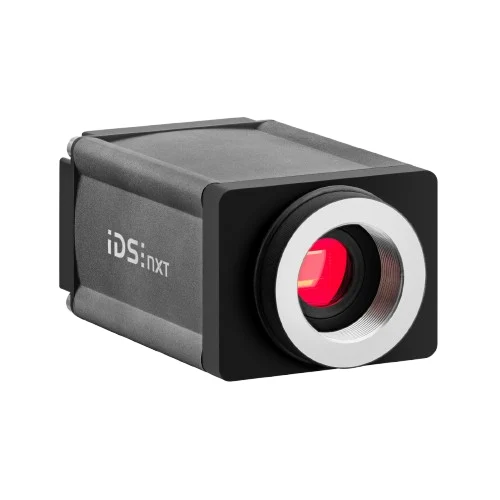
IDS 1012077 NXT oslo RS18083C-HQ 8.29 MP AI Camera

Integrate IDS 1012077 NXT oslo with 8.29 MP color imaging, onboard neural processing, M12 Ethernet, event recording and PoE in an aluminum housing.

SKU: IDS-1012077 Category:
IDS NXT Cameras

IDS NXT oslo RS18083C-HQ AI Camera

BrandIDS
Model IdentifierIDS NXT oslo RS18083C-HQ
Official Part Number1012077

Technical Overview

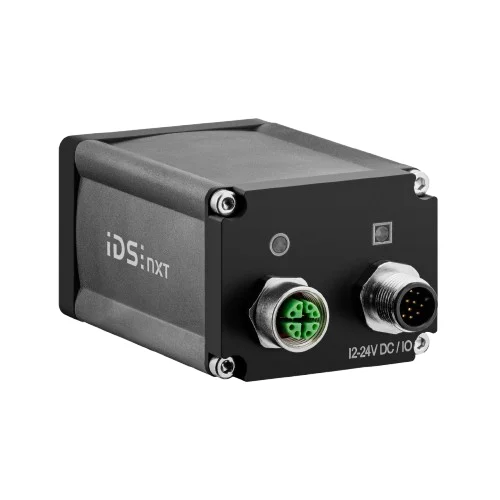
The IDS NXT oslo RS18083C-HQ is a 8.29 MP color AI camera combining an Sony IMX678-AAQR1-C rolling-shutter CMOS sensor with hardware-accelerated image processing. Its Ambarella system-on-chip includes a neural processing unit for running trained neural networks directly on the camera and providing results through REST or video overlays. H.264 and MJPEG compression, RTSP streaming and event recording support process observation without a separate capture PC. The aluminum housing provides IP66, IP67, IP69 and IPx9K protection, with screwable M12 Ethernet and twelve-pin M12 I/O. C-mount optics, optocoupled inputs and outputs, and 12–24 V or PoE power support integration into industrial equipment.

8.29 MP color rolling-shutter AI camera with onboard neural processing, C-mount, M12 Ethernet, optocoupled I/O and PoE.

Key Features

  • Sony IMX678-AAQR1-C color CMOS sensor
  • 3840 × 2160 pixels; 2 µm pixel size
  • Rolling shutter; linear response; 12-bit ADC and 8-bit camera data
  • 1.00 Gbps Ethernet with screwable M12 connection
  • Ambarella SoC with onboard neural processing unit
  • C-mount lens interface; 1/1.8-inch optical sensor class
  • 12-pin M12 I/O with two optocoupled inputs and two optocoupled outputs
  • H.264 and MJPEG video; RTSP streaming and event recording
  • Aluminum housing; IP66, IP67, IP69 and IPx9K protection
  • 12–24 V or PoE; 5.5 W external-power or 7.2 W PoE consumption

Run trained neural networks on the camera and deliver results through REST or live-video overlays for integrated visual inspection.

Technical Specification Matrix

ParameterValue
Camera familyIDS NXT oslo
Sensor manufacturerSony
Sensor modelIMX678-AAQR1-C
Sensor typeColor CMOS
ShutterRolling shutter
Sensor characteristicLinear
Pixel class8 MP
Resolution8.29 MP; 3840 × 2160 pixels
Aspect ratio16:9
Sensor ADC12 bit
Camera color depth8 bit
Optical sensor class1/1.8-inch
Optical sensor area7.680 × 4.320 mm
Optical sensor diagonal8.81 mm
Pixel size2 µm
Chief ray angle0°
Free-running acquisition rate27 fps
Continuous trigger acquisition rate10 fps
Maximum trigger acquisition rate10 fps
Exposure time0.031–33.333 ms
ProcessorAmbarella system-on-chip; neural processing unit and image signal processor
AI processingTrained neural networks execute on the camera; results through REST or stream overlays
Video compressionH.264; MJPEG
Streaming protocolsRTSP; HTTP
Streaming profiles, manufacturer store3840 × 2160; 2560 × 1440; 2592 × 1944; 1920 × 1080; 1440 × 1080; 1280 × 720; 640 × 480; listed at 30 fps
Parallel video streamsUp to three RTSP streams
Event recordingSoftware or I/O-triggered video sequences; persistent camera storage or FTP transfer
Network interfaceEthernet; 1.00 Gbps
Interface connectorGigE M12, screwable
I/O connector12-pin M12; Attend 216A-12MSR
Power supply12–24 V or PoE
Power consumption, PoE7.2 W
Power consumption, external supply5.5 W
I/O pin 1Supply input, 12–24 V
I/O pin 2Power supply ground
I/O pin 3Input 2, optocoupled (+)
I/O pin 4Input 1, optocoupled (+)
I/O pin 5Input 1, optocoupled (−)
I/O pin 6Output 1, optocoupled (−)
I/O pin 7Output 1, optocoupled (+)
I/O pin 8Output 2, optocoupled (+)
I/O pin 9GPIO 1
I/O pin 10GPIO 2
I/O pin 11Input 2, optocoupled (−)
I/O pin 12Output 2, optocoupled (−)
Lens mountC-mount
IP ratingIP66; IP67; IP69; IPx9K
Housing materialAluminum
Operating outer-housing temperature0 to +55 °C
Storage ambient temperature−20 to +60 °C
Relative humidity0–100%, non-condensing
Acquisition modesFree-running; software trigger; hardware trigger
Automatic image adjustmentsAuto exposure; auto gain; auto white balance
Image orientationX/Y mirror/flip
Region of interestSupported
Firmware updateSupported
First supported firmware version4.3.0
Physical Weight (kg)0.285
Dimensions L x W x H (cm)7.50 x 5.30 x 4.10
Sensor technologySony STARVIS 2

Industrial Applications

1. Stationary Assembly Completeness Inspection

An assembly fixture holds a product stationary while a trained neural network evaluates whether visible components are present. The IDS NXT oslo RS18083C-HQ captures a 3840 × 2160 color image and runs the configured analysis on its onboard NPU. Software or hardware triggering associates capture with the assembly step, and REST result delivery connects the visual decision to the surrounding production application.

Problem Solved

Onboard inference supplies the configured assembly result without transferring each image to a separate inference PC. Triggered capture relates that result to the stationary product presented at the fixture.

Onboard NPU Hardware trigger REST

2. Appearance-Based Product Classification

A sorting fixture presents stationary products whose visible colors or shapes distinguish their classes. The IDS NXT oslo RS18083C-HQ combines a color sensor with onboard execution of a trained neural network, enabling the configured application to assign a visual class. Region-of-interest selection concentrates evaluation on the presented product, while the REST interface makes the resulting class available to the equipment’s supervisory application.

Problem Solved

Color image capture and onboard neural processing support classification from visible appearance. REST result delivery gives the supervisory application the configured classification output for its subsequent handling sequence.

Color CMOS Region of interest Onboard AI

3. Intermittent Machine Event Review

A packaging or handling machine can experience occasional jams that are difficult to observe during normal operation. The IDS NXT oslo RS18083C-HQ streams compressed video to an operator client and records sequences when software or an I/O signal marks an event. Persistent camera storage or FTP transfer preserves the sequence for review, helping maintenance staff examine the visible process around the reported interruption.

Problem Solved

Event-triggered recording preserves a visual sequence associated with the reported interruption. Compressed RTSP video provides an observation channel, allowing staff to review visible machine behavior while investigating an intermittent process fault.

Event recording RTSP H.264