1. Local Inert-Gas Regulator Adjustment
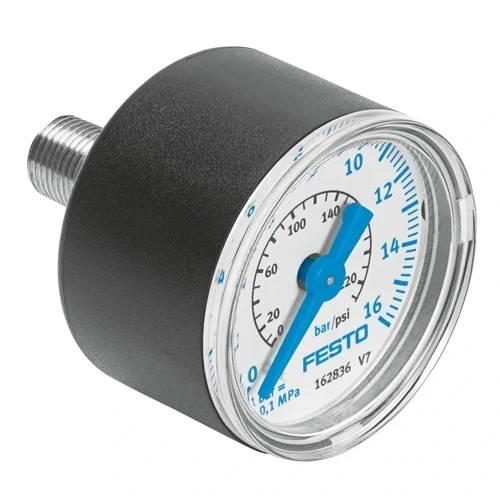
A production workstation sets an inert-gas regulator before a process run. Connected through the centred rear R1/4 interface, the gauge provides a local 0–16 bar reading while the operator adjusts the regulator. Its Bourdon-tube mechanism presents pressure directly at the installation, and accuracy class 2.5 defines the instrument's indication class for the task.
Problem Solved
Direct local indication gives the operator pressure feedback while adjusting an inert-gas regulator, avoiding reliance on an unobserved regulator position as the process setting.
0–16 bar
Inert gas
R1/4 rear connection
2. Neutral-Fluid Transfer-Line Pressure Indication
A machine transferring a neutral fluid needs an accessible pressure indication during startup and inspection. The gauge's documented media suitability includes neutral fluids, with brass wetted components and a 0–16 bar operating range. Its rear connection supports inline installation, while the −20 to +60 °C media limit defines the usable temperature envelope at the measurement point.
Problem Solved
An inline mechanical gauge makes fluid-line pressure visible at the machine, helping operators observe startup conditions within the instrument's documented media, pressure and temperature limits.
Neutral fluids
Brass wetted parts
−20 to +60 °C media
3. Commissioning with Bar and Psi Documentation
An equipment commissioning team works with a machine specification written in bar and a customer procedure written in psi. The gauge's outer bar scale and inner psi scale provide both readings on the same instrument. This supports comparing the observed pressure with either document at the measurement point without repeatedly converting a single-unit dial reading.
Problem Solved
Two pressure scales let technicians relate one local measurement to bar-based and psi-based procedures, reducing the need for a separate unit-conversion step during commissioning.
Outer bar scale
Inner psi scale
EN 837-1