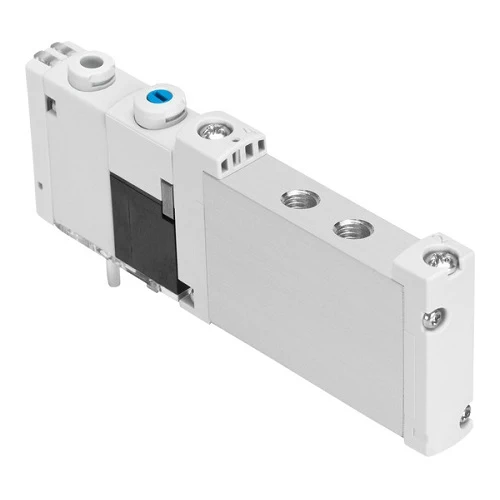
1. Reciprocating Part-Transfer Cylinder
An assembly machine uses a double-acting cylinder to transfer a component between two positions. The 5/2-way valve changes the air connections through M5 working ports using a solenoid command and spring reset. Its 10 mm size and manifold-rail mounting support a grouped pneumatic control assembly, while the E-box provides the electrical connection and LEDs show the signal state during commissioning.
Problem Solved
A solenoid command and spring reset provide the two directional states needed for cylinder movement, while M5 connections and compact manifold mounting group the transfer controls.
5/2-way
M5 working ports
10 mm valve
2. Pneumatic Gripper Open-and-Close Sequencing
A handling unit uses a double-acting gripper whose working pressure is set separately from the valve actuation supply. External pilot air at 1.5–8 bar operates the single-solenoid 5/2-way valve independently of the working circuit. This arrangement supports a gripper circuit in which directional actuation and spring reset use a separate pilot-air supply arrangement.
Problem Solved
Separate pilot air allows the valve actuation supply and gripper working pressure to be arranged independently, while a solenoid command and spring reset select the directional state.
External pilot
1.5–8 bar pilot
Single solenoid
3. Two-Position Product Diverter Actuation
A packaging conveyor uses a pneumatic actuator to move a product diverter between two routes. The valve changes the actuator air connections through its 5/2-way circuit, with 9 ms switch-on and 21 ms switch-off times. Its maximum switching frequency of 3 Hz provides a concrete valve limit for planning directional commands alongside actuator and load response.
Problem Solved
Documented switch-on, switch-off and frequency ratings support planning diverter commands, while the 5/2-way valve provides the directional air routing and reset action required by the actuator circuit.
9 ms on
21 ms off
3 Hz maximum