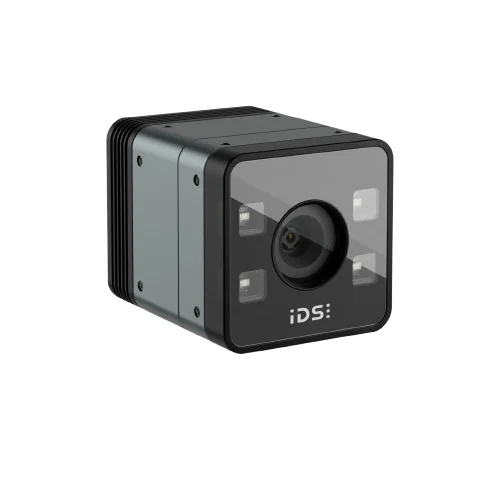
| Camera family | Nion |
| Sensing principle | Indirect time of flight, iToF |
| Sensor manufacturer | onsemi |
| Sensor model | AF0130CSSM30SMKA1 |
| Sensor type | Monochrome CMOS; stacked back-side illuminated sensor |
| Shutter | Global shutter |
| Pixel class | 1.2 MP |
| Resolution | 1.23 MP; 1280 × 960 pixels |
| Pixel size, sensor manufacturer | 3.5 × 3.5 µm |
| Sensor optical format, onsemi | 1/3.2-inch; 5.60 mm diagonal; 4:3 aspect ratio |
| Sensor chief ray angle, onsemi | 30° |
| Processing | AF0130 stacked ASIC calculates depth, confidence and intensity data |
| Phase acquisition | Four phase exposures buffered in the sensor before readout |
| Free-running frame rate | 30 fps |
| Continuous trigger frame rate | 30 fps |
| Maximum trigger frame rate | 30 fps |
| Exposure time | 0.0038–1.00203 ms |
| Working distance | 0.3–7.5 m |
| Laser wavelength | 940 nm |
| Laser class | 1 |
| Integrated optics field of view | 71° horizontal; 57° vertical; 91° diagonal |
| Special camera functions | Overlap trigger; sensor source gain |
| Master gain | 8× |
| Horizontal / vertical AOI rate effect | Same frame rate |
| AOI minimum width / increment | 320 / 4 pixels |
| AOI minimum height / increment | 2 / 2 pixels |
| AOI position grid, horizontal / vertical | 4 / 2 pixels |
| Sensor binning | 4 × 4; horizontal and vertical mean; same frame rate |
| Power consumption, PoE++ | 18.4 W |
| Power consumption, external supply | 16.7 W |
| Power supply | 12–24 V or PoE++ |
| Network interface | Ethernet; 1.00 Gbps |
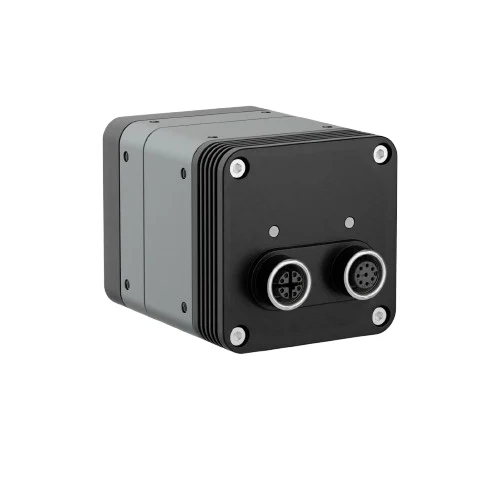
| Interface connector | GigE M12, screwable |
| I/O connector | 8-pin M12 |
| I/O pin 1 | Optocoupled trigger input (+); Line 0 |
| I/O pin 2 | Optocoupled trigger input (−); Line 0 |
| I/O pin 3 | Optocoupled flash output (−); Line 1 |
| I/O pin 4 | Optocoupled flash output (+); Line 1 |
| I/O pin 5 | Power supply ground |
| I/O pin 6 | Supply input, 12–24 V |
| I/O pin 7 | GPIO 1, 3.3 V; Line 2 |
| I/O pin 8 | GPIO 2, 3.3 V; Line 3 |
| IP rating | IP66; IP67 |
| Operating outer-housing temperature | 0 to +55 °C |
| Operating ambient temperature, manufacturer store | 0 to +35 °C |
| Storage ambient temperature | −20 to +60 °C |
| Relative humidity | 0–100%, non-condensing |
| Physical Weight (kg) | 0.370 |
| Dimensions L x W x H (cm) | 7.50 x 6.00 x 6.00 |
| Operating mode Uar750QuadVga | Unambiguous range 0.75 m; modulation 200 MHz; maximum exposure 1002.03 µs; 2D resolution 1280 × 960 pixels; published accuracy ±5.0 mm ± 0.25% of depth |
| Published precision, Uar750QuadVga | ±0.8 mm at 0.5 m; ±1.2 mm at 1 m |
| Operating mode Uar860QuadVga | Unambiguous range 0.86 m; modulation 175 MHz; maximum exposure 1002.03 µs; 2D resolution 1280 × 960 pixels; published accuracy ±5.0 mm ± 0.25% of depth |
| Published precision, Uar860QuadVga | ±1.1 mm at 0.5 m; ±1.5 mm at 1 m |
| Operating mode Uar1250QuadVga | Unambiguous range 1.25 m; modulation 120 MHz; maximum exposure 1002.03 µs; 2D resolution 1280 × 960 pixels; published accuracy ±10.0 mm ± 0.5% of depth |
| Published precision, Uar1250QuadVga | ±1.4 mm at 0.5 m; ±1.9 mm at 1 m; ±3.0 mm at 1.5 m |
| Operating mode Uar1500QuadVga | Unambiguous range 1.5 m; modulation 100 MHz; maximum exposure 1002.03 µs; 2D resolution 1280 × 960 pixels; published accuracy ±10.0 mm ± 0.5% of depth |
| Published precision, Uar1500QuadVga | ±1.5 mm at 0.5 m; ±2.6 mm at 1 m; ±4.4 mm at 1.5 m |
| Operating mode Uar2000QuadVga | Unambiguous range 2 m; modulation 75 MHz; maximum exposure 1002.03 µs; 2D resolution 1280 × 960 pixels; published accuracy ±15.0 mm ± 1% of depth |
| Published precision, Uar2000QuadVga | ±2.1 mm at 0.5 m; ±3.2 mm at 1 m; ±5.5 mm at 1.5 m; ±8.3 mm at 2 m |
| Operating mode Uar3000QuadVga | Unambiguous range 3 m; modulation 50 MHz; maximum exposure 1002.03 µs; 2D resolution 1280 × 960 pixels; published accuracy ±15.0 mm ± 1% of depth |
| Published precision, Uar3000QuadVga | ±3.3 mm at 0.5 m; ±4.5 mm at 1 m; ±7.1 mm at 1.5 m; ±10.1 mm at 2 m; ±18.0 mm at 3 m |
| Operating mode Uar6000Vga | Unambiguous range 6 m; modulation 175, 200 MHz; maximum exposure 499.11 µs; 2D resolution 640 × 480 pixels; published accuracy ±5.0 mm ± 0.25% of depth |
| Published precision, Uar6000Vga | ±0.6 mm at 0.5 m; ±0.9 mm at 1 m; ±1.3 mm at 1.5 m; ±1.7 mm at 2 m; ±2.9 mm at 3 m; ±4.8 mm at 4 m; ±7.4 mm at 5 m |
| Operating mode Uar7500Vga | Unambiguous range 7.5 m; modulation 100, 120 MHz; maximum exposure 499.11 µs; 2D resolution 640 × 480 pixels; published accuracy ±10.0 mm ± 0.5% of depth |
| Published precision, Uar7500Vga | ±0.8 mm at 0.5 m; ±1.2 mm at 1 m; ±1.8 mm at 1.5 m; ±2.4 mm at 2 m; ±4.2 mm at 3 m; ±6.6 mm at 4 m; ±9.2 mm at 5 m; ±12.4 mm at 6 m |