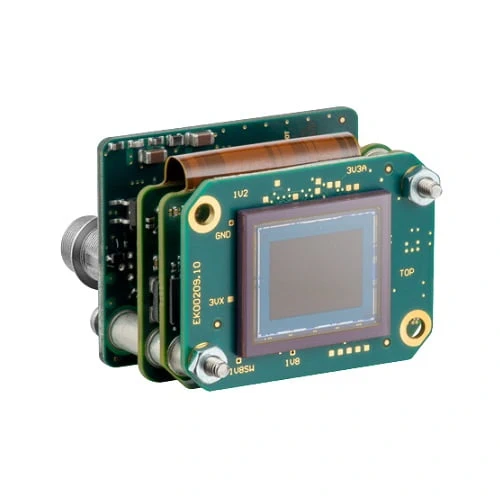
IDS AB12294 GV-5292SE-M Rev.4.2 8.95 MP Camera

Capture 4112 × 2176-pixel monochrome images with a Sony global-shutter board camera, no lens holder, GigE Vision, 128 MB memory and optocoupled I/O.

SKU: IDS-AB12294 Category:
IDS SE Cameras

IDS GV-5292SE-M Rev.4.2 8.95 MP Monochrome GigE Vision Camera

BrandIDS
Model IdentifierGV-5292SE-M Rev.4.2
Official Part NumberAB12294

Technical Overview

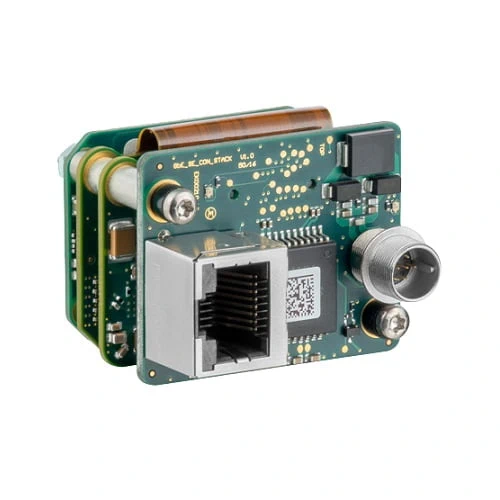
The IDS GV-5292SE-M Rev.4.2 is a monochrome board-level GigE Vision camera using the Sony IMX267LLR-C global-shutter CMOS sensor. Its 8.95 MP image contains 4112 × 2176 pixels at 3.45 µm pixel size, providing spatial image data for host inspection under controlled illumination. The version without a lens holder combines 128 MB image memory with region-of-interest selection, FPGA decimation and binning, and a denoiser. Optocoupled trigger and flash signals are available on its eight-pin Hirose connector, while an RJ45 Ethernet interface and 12–24 V DC or PoE supply support integration into a machine enclosure.

8.95 MP monochrome global-shutter board camera with Sony IMX267LLR-C, no lens holder, GigE Vision, 128 MB memory and PoE.

Key Features

  • Sony IMX267LLR-C monochrome CMOS sensor
  • 4112 × 2176 pixels; 3.45 µm pixel size
  • Global shutter; 13 fps freerun and 14 fps triggered acquisition
  • 12-bit ADC and 12-bit camera color depth
  • GigE Vision, 1.00 Gbps Ethernet and RJ45 connector
  • Denoiser, region of interest, FPGA decimation and FPGA binning
  • No lens holder; 1-inch optical sensor class
  • 8-pin Hirose connector with optocoupled trigger and flash signals
  • 128 MB image memory; 12–24 V DC or PoE power
  • 38 g board-level camera; IP0

Capture 4112 × 2176-pixel component outlines with global exposure and optocoupled triggering for timed GigE Vision inspection.

Technical Specification Matrix

ParameterValue
Sensor manufacturerSony
Sensor modelIMX267LLR-C
Sensor typeCMOS monochrome
ShutterGlobal shutter
Sensor characteristicLinear
Resolution8.95 MP; 4112 × 2176 pixels
Aspect ratio17:9
ADC12 bit
Camera color depth12 bit
Optical sensor class1-inch
Optical sensor area14.159 × 7.500 mm
Optical sensor diagonal16.02 mm
Pixel size3.45 µm
Chief ray angle0°
Gain, master / RGB25.4× / −
Horizontal AOISame frame rate
Vertical AOIIncreased frame rate
AOI width minimum / step256 / 2 pixels
AOI height minimum / step1 / 1 pixels
AOI position grid, horizontal / vertical2 / 1 pixels
Frame rate, freerun13 fps
Frame rate, continuous trigger14 fps
Frame rate, maximum trigger14 fps
Exposure time0.046–2000 ms
Image memory128 MB
Power supply12–24 V DC or PoE
Interface standardGigE Vision
Interface bandwidthEthernet, 1.00 Gbps
Interface connectorGigE RJ45
I/O connector8-pin Hirose HR25-7TR-8PA(73)
Lens mountNo mount
IP ratingIP0
Allowed device temperature during operation0–55 °C
Allowed ambient temperature during storage−20–60 °C
Relative humidity20–80%, non-condensing
Acquisition modesFreerun; software trigger; hardware trigger
Image processingDenoiser; region of interest; FPGA decimation; FPGA binning
Image adjustmentAuto exposure; auto gain; gamma; LUT; X/Y mirror/flip
Flashing modesFlashing; PWM flashing
Network functionsIP settings; bandwidth management; chunks; PTP
Firmware updateSupported
First supported firmware version2.10
Pixel formatsMono8; Mono10; Mono10p; Mono12; Mono12p
I/O pin 1Ground
I/O pin 2Optocoupled flash output negative; Line1
I/O pin 3GPIO 1; Line2
I/O pin 4Optocoupled trigger input negative; Line0
I/O pin 5Optocoupled flash output positive; Line1
I/O pin 6GPIO 2; Line3
I/O pin 7Optocoupled trigger input positive; Line0
I/O pin 812–24 V DC input
Physical Weight (kg)0.038
Dimensions L x W x H (cm)3.00 x 4.00 x 3.15
Long exposure, maximum90000 ms
Line rate, freerun line scan763 lines/s
Line rate, triggered line scan823 lines/s
Lines per frame, line scan8000
HDR modeSequencer
Trigger-controlled exposureSupported
Line scanSupported
Power consumption1.7–3.1 W
Sensor decimation2 × 2
Sensor binning2 × 2; horizontal and vertical addition

Industrial Applications

1. Conveyor Component Position Inspection

A conveyor inspection station records components before a downstream handling step. Global-shutter exposure keeps the component edges within a common capture interval, avoiding row-dependent displacement as the parts move. Hardware-triggered acquisition supplies a timed 4112 × 2176-pixel monochrome view, allowing the host to compare the part outline and orientation with the expected handling window under controlled illumination.

Problem Solved

Global exposure preserves relative edge positions within each frame. Hardware-triggered capture supplies a consistent observation point for host evaluation of component placement and orientation before handling.

Global shutter Hardware trigger 4112 × 2176

2. Surface Blemish Reference Comparison

An inspection fixture presents a machined or coated part under controlled illumination to reveal scratches and local finish differences. The camera records a 8.95 MP monochrome view, while region-of-interest selection concentrates the image on the working surface. Its 12-bit camera output supplies intensity values for host comparison with a reference finish, and software-triggered capture requests an image after the presented part settles.

Problem Solved

Image sampling and 12-bit output preserve local brightness patterns for host comparison. Region selection concentrates the recorded view on the working area being examined for scratches and finish differences.

8.95 MP 12-bit output Region of interest

3. Fixtured Identifier Pattern Comparison

A packaging workstation presents printed labels or marked identifiers for host comparison with an expected character and symbol pattern. A software trigger requests a 4112 × 2176-pixel monochrome image after the target settles. Region-of-interest selection concentrates the captured view on the marking, and 12-bit camera output provides image values for comparing print and background patterns under controlled illumination.

Problem Solved

Software-requested capture records the presented marking after it settles. Spatial sampling and region selection provide the host with a consistent view for comparing printed characters and symbols with the expected pattern.

4112 × 2176 Software trigger 12-bit output