
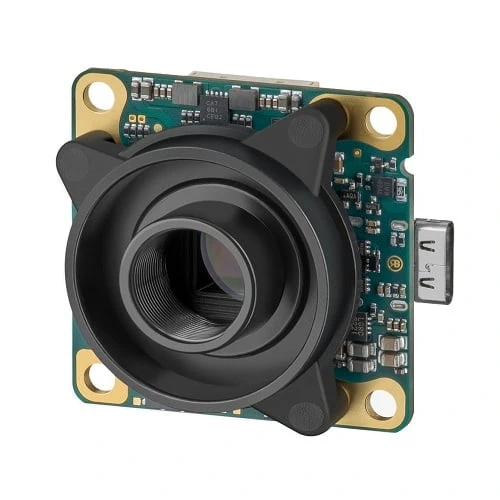
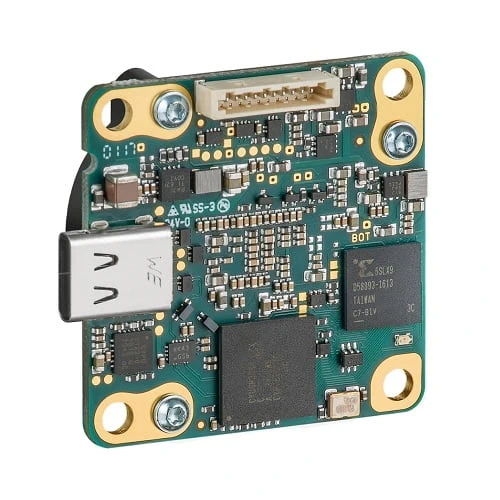
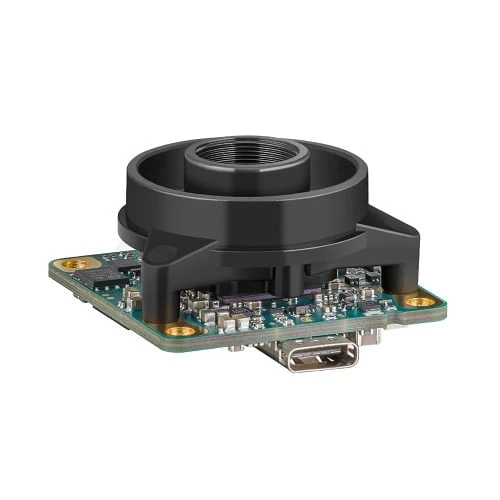
Technical Capabilities
-
1.6 MP CMOS Global Shutter Sensor – 1456 × 1088 resolution for motion-free inspection and precise measurement
-
Up to ~235 fps @ Full Resolution – High-speed performance for fast production lines and dynamic scenes
-
USB3 Vision Interface (USB Type-C) – High-bandwidth, low-latency data transfer for real-time image acquisition
-
Global Shutter Architecture – Accurate capture of fast-moving objects without geometric distortion
-
Advanced Image Control – Programmable exposure, gain, long exposure, ROI, binning, and decimation
-
Industrial SDK & GenICam Support – Seamless system integration via the IDS Imaging Development Systems software ecosystem
Specifications
- Color: U3-3041LE-C-HQ (AB03438)
- Mono: U3-3041LE-M-GL (AB03439)
| Feature | Details | Benefit |
|---|---|---|
| Sensor Brand & Model | Sony IMX273 (Color: IMX273LQR / Mono: IMX273LLR) | Proven global shutter sensor ensures accurate, distortion-free capture |
| Interface | USB3 Vision (USB Type-C) | High compatibility and easy integration with industrial PCs |
| Interface Speed | USB 3.0 SuperSpeed | Supports high frame rates with low latency |
| Resolution (H × V) | 1456 × 1088 pixels (1.6 MP) | Optimized balance between detail and speed |
| Optical Area (H × V) | 4.996 mm × 3.747 mm | Efficient coverage for compact optics |
| Optical Format | 1/3″ (Diagonal 6.25 mm) | Suitable for small, cost-effective lenses |
| Lens Mount | S-Mount (M12) | Ideal for compact and embedded vision designs |
| Pixel Size | 3.45 µm × 3.45 µm | Good sensitivity with fast readout performance |
| Image Memory | None (direct streaming) | Minimizes latency and simplifies system design |
| Frame Rate @ Max. Resolution | Up to 235 fps (freerun) | Enables high-speed inspection and motion analysis |
| Shutter | Global Shutter | Eliminates motion artifacts on moving objects |
| Exposure Time | 0.022 ms to 2000 ms (long exposure up to ~30 s) | Flexible operation from high-speed to low-light scenes |
| Trigger & Flash I/O | Hardware trigger, software trigger, flash output, GPIO | Precise synchronization with external devices |
| Power Supply | Via USB (1–2 W typical) | Low power consumption for continuous operation |
| Software Tools | IDS peak SDK, GenICam compliant | Fast development and broad software compatibility |
| Environmental Tolerance | Operating: 0 °C to 55 °C, 20–80% RH (non-condensing) | Reliable performance in industrial environments |
| Housing Protection | Open PCB design (no IP rating) | Lightweight and flexible for embedded integration |
| Size & Weight | 36 × 36 × 19.9 mm, approx. 16 g | Compact form factor for space-constrained systems |
Ideal Applications
1. High-Speed Conveyor Inspection for Small Components
In automated production lines, small parts often travel at high speed, making accurate visual inspection challenging. A global shutter sensor allows the camera to capture the entire scene at once, preventing image distortion caused by motion. With high frame rates, multiple images can be acquired in rapid succession, improving defect detection without slowing the line. Precise trigger and flash control help maintain consistent illumination and timing, even in fast cycles. This approach supports reliable identification of missing features, surface defects, and dimensional deviations in electronics, medical devices, and precision mechanical manufacturing environments.
2. Robotic Pick-and-Place Positioning Accuracy
Robotic handling systems depend on clear and distortion-free images to calculate accurate pick coordinates. A global shutter camera ensures that moving parts and robot arms are captured without skew, even during rapid motion. High-speed image acquisition allows the vision system to respond quickly, keeping pace with short cycle times. Adjustable regions of interest and image scaling reduce data processing overhead while preserving critical detail. These capabilities help improve placement accuracy, reduce mispicks, and increase overall throughput in automated assembly and packaging systems.
3. Motion Evaluation in Automated Machinery
Analyzing mechanical motion requires consistent image timing and reliable frame-to-frame comparison. A high-speed global shutter sensor captures moving components without geometric distortion, making it easier to evaluate alignment, vibration, or timing behavior. Fast frame rates allow short-duration events to be observed and analyzed in detail. Combined with flexible exposure control, the system can adapt to different lighting conditions found on factory floors. This makes the camera suitable for performance analysis, fault detection, and optimization of industrial automation equipment.
4. Embedded Vision in Space-Constrained Systems
Many embedded vision projects face limitations in size, power, and system complexity. A compact camera using a balanced global shutter sensor can deliver reliable imaging while fitting into tight mechanical spaces. High-speed USB connectivity simplifies integration and reduces the need for additional interface hardware. Low power consumption supports continuous operation in enclosed environments. These characteristics make the camera suitable for compact inspection modules, smart devices, and integrated monitoring systems where stable imaging and long product availability are critical.
5. Optical Measurement and Inline Dimensional Control
Accurate optical measurement depends on capturing sharp, undistorted images of object edges and features. A global shutter sensor ensures that measurements remain precise even when objects are moving slightly or subject to vibration. High frame rates enable repeated measurements within short time intervals, improving statistical confidence. Fine exposure adjustment and synchronized triggering support consistent results across different materials and surface finishes. This makes the camera well suited for inline dimensional inspection, gauging, and quality control in precision manufacturing processes.