
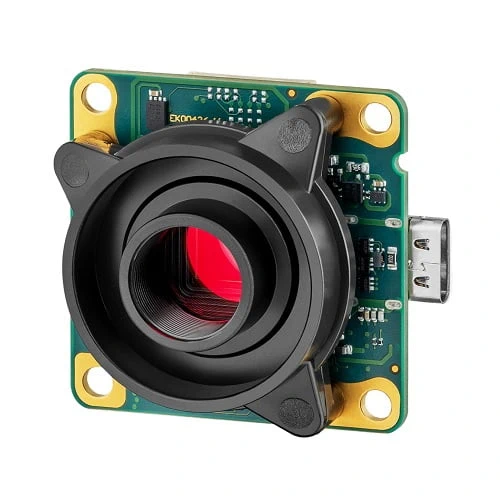
IDS U3-3681XLE-NIR-GL Rev.1.1 NIR USB3 Type-C camera with 5 MP mono imaging, hardware trigger and strobe for stable, high-speed inspection.
IDS Imaging U3-3681XLE-NIR-GL Rev.1.1 is a compact near-infrared (NIR) USB3 Type-C industrial camera built for inspection tasks where visible light cannot reveal enough contrast. With a 5 MP monochrome sensor and high frame-rate capability, it captures fine surface detail and subtle material differences for automated vision systems. The 12-bit image output supports better grayscale separation for measurement and defect detection, while trigger and strobe interfaces help deliver repeatable results on moving parts. This model is best suited for maintaining existing systems or matching legacy installations.
IDS Imaging U3-3681XLE-NIR-GL Rev.1.1 improves reliability in applications like ink verification, coating inspection, fill-level checks, and material sorting by using NIR sensitivity to expose features that often disappear under standard lighting. Its small, lightweight housing is designed for tight mechanical envelopes and fast machine integration. Hardware triggering and flash output enable synchronized capture to reduce motion blur and stabilize brightness, which is critical for metrology and high-speed pass/fail inspection. Bandwidth-saving controls such as region-of-interest and pixel binning help maintain throughput while preserving the detail you need.
Choose U3-3681XLE-NIR-GL Rev.1.1 when you need a compact industrial camera that “sees beyond” visible light. Its NIR-ready monochrome imaging helps reveal hidden contrasts in inks, coatings, liquids, and polymers, while USB3 Type-C keeps integration simple. Add hardware trigger and strobe output, and you get stable, repeatable images even on fast-moving production lines.
It solves the classic machine-vision failure mode: your target looks identical under normal lighting. This camera’s NIR sensitivity increases contrast where visible cameras struggle—making it easier to detect print marks, inspect coatings, verify fills, and separate similar-looking materials. With synchronized triggering, it also reduces motion blur and brightness variation that cause false rejects.
| Feature | Details | Benefit |
|---|---|---|
| Sensor Brand & Model | onsemi AR0522SRSM09SURA0 (CMOS, Mono, NIR-optimized response) | Improves contrast in NIR illumination for material/ink/coating differentiation |
| Interface | USB (U3 series) via USB Type-C | Simple, modern connectivity for embedded and industrial PCs |
| Interface Speed | USB3-class bandwidth (via USB Type-C) | Supports high data throughput for higher FPS and larger images |
| Resolution (H×V) | 2592 × 1944 | Captures fine detail for inspection, measurement, and classification |
| Resolution (Total) | 5.04 MP | Higher spatial detail to reduce missed defects and improve feature extraction |
| Optical Area (H×V) | 5.702 mm × 4.277 mm | Helps select the correct lens for your required field of view |
| Optical Format | 1/2.5″ (Diagonal 7.13 mm) | Simplifies lens matching and imaging system design |
| Pixel Size | 2.2 µm | Better small-feature visibility and improved sampling for precision inspection |
| Shutter | Rolling shutter | Efficient readout for high frame rate machine-vision workflows |
| ADC / Output Depth | 12-bit | Smoother grayscale separation for thresholds, segmentation, and metrology |
| Frame Rate @ Max. Resolution | 48 fps (freerun); 44 fps (triggered) | Enables faster conveyors and higher takt time without losing detail |
| Exposure Time | 0.01 ms to 635 ms | Covers high-speed freeze-frame capture through to low-light NIR imaging |
| Image Memory | None (—) | Predictable streaming behavior; relies on host buffering and processing |
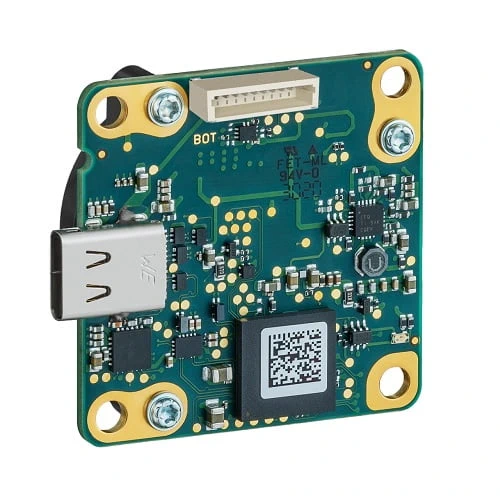
| Trigger & Flash I/O | Hardware trigger + flash output via 8-pin Wuerth I/O connector | Deterministic capture timing and synchronized lighting for repeatable results |
| I/O Electrical (Key Pins) | 3.3 V output; Trigger input (Line 0); Flash output (Line 1); USB Power 5 V, max. 400 mA; multiple GND pins | Straightforward integration with PLC/IO modules and strobed illumination |
| Power Supply | Powered via USB cable | Reduces wiring complexity and cabinet power provisioning |
| Power Consumption | 0.6 W to 1.2 W | Supports fanless/embedded designs and multi-camera deployments |
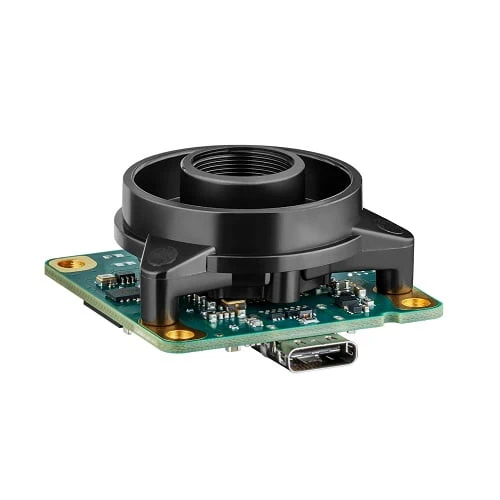
| Lens Mount | S-Mount | Compact optics options for tight installation envelopes |
| Size & Weight | 36.0 × 36.0 × 21.0 mm; 13 g | Fits space-constrained machines and lightweight motion stages |
| Environmental Tolerance (Operating) | 0 °C to 85 °C | Suitable for warm industrial enclosures and continuous operation |
| Environmental Tolerance (Storage) | -20 °C to 80 °C | Better resilience for logistics, spares, and maintenance storage |
| Humidity | 20% to 80% RH (non-condensing) | Supports typical factory conditions when properly enclosed |
| Housing Protection (IP) | Not rated (—) | Indicates enclosure planning is required for dust/washdown areas |
| On-board Processing | ROI; Sensor binning 2×2; Sensor decimation 2×(2,4); Mirror/Flip X/Y | Optimizes bandwidth and orientation without extra mechanical changes |
| Pixel Formats | Mono8; Mono10g40IDS; Mono12g24IDS | Balances bandwidth vs. precision for inspection and measurement tasks |
| Software Tools | IDS peak (host-side feature access and control) | Faster commissioning and stable integration in production software stacks |
| Firmware Support | Firmware update supported; first supported firmware version 2.11 | Supports maintenance, compatibility management, and controlled upgrades |
On high-speed packaging lines, black inks, low-contrast date codes, and varnished surfaces can defeat visible-light cameras, creating false rejects or missed reads. A system based on the AR0522 NIR-capable monochrome sensor improves separation between ink, substrate, and coatings when paired with near-infrared illumination. The 5 MP resolution helps OCR and verification algorithms resolve thin characters and dot patterns, while 12-bit output preserves subtle grayscale differences for stable thresholding. Use a region-of-interest to stream only the code area for higher throughput. Hardware trigger and strobe output synchronize capture and lighting to reduce motion blur on moving webs and conveyors.
Many coatings and thin adhesive layers look “invisible” under normal lighting, especially on glossy plastics, foils, or treated metals. NIR imaging with an AR0522-based camera can reveal reflectance and absorption differences that make these layers measurable and repeatable. The sensor’s 12-bit depth supports robust segmentation of faint contrast changes, useful for confirming bead continuity, edge coverage, or missing sections before curing. In production, you can trigger the camera at a precise encoder position and fire a short NIR strobe to freeze motion. When line speed changes, exposure control and ROI keep the system responsive, maintaining inspection reliability without overloading bandwidth.
Transparent or tinted containers often cause visible-light glare, confusing fill-level inspection—particularly with curved surfaces and variable ambient light. Near-infrared setups using the AR0522 monochrome sensor can improve boundary visibility between liquid and air, and can reduce sensitivity to label graphics or reflections when the illumination and optics are tuned. The 5 MP resolution supports accurate meniscus localization and tilt compensation for moving containers. By cropping to a narrow ROI around the expected level, the system increases frame rate and reduces processing load. Triggered acquisition with synchronized lighting produces consistent results across speed changes, making it suitable for in-line QC on fillers.
In sorting lines, different polymers or films can appear nearly identical in visible light, especially when colors or surface finishes vary. NIR-sensitive monochrome imaging helps distinguish materials by their differing responses under near-infrared illumination, improving classification confidence for automated pick-and-place or air-jet separation. The AR0522 sensor’s 12-bit capture supports more stable feature extraction when material differences are subtle, and the 5 MP resolution helps identify small fragments or contamination. Use binning or decimation when prioritizing speed over fine detail, and switch to full resolution for difficult zones. Hardware trigger ensures consistent imaging geometry at high conveyor speeds.
Autonomous mobile robots often face mixed lighting—dark aisles, bright loading bays, reflective floors, and fast transitions that degrade tracking. An AR0522-based camera benefits navigation and inspection by maintaining usable contrast in low light and preserving details that feed visual odometry or marker detection. The compact form factor supports tight mechanical integration on robot masts or arms, while USB3 connectivity simplifies deployment on embedded compute platforms. For motion-heavy tasks, hardware triggering combined with strobed NIR lighting reduces blur and stabilizes brightness, improving repeatability for barcode reads, docking alignment, and obstacle detection. ROI streaming helps sustain real-time performance while conserving bandwidth.
3 Type-C Industrial Cables – Stable high-bandwidth connection, secure fit
IDS Imaging Cameras
As an authorized distributor of IDS products, we offer certified expertise and technical support to ensure you get the most out of your U3-3681XLE-NIR-GL Rev.1.1 camera. We stand by the quality of our products and provide comprehensive warranty services. Our team can also assist with special services like custom integration and creating pre-configured kits tailored to your specific needs.