
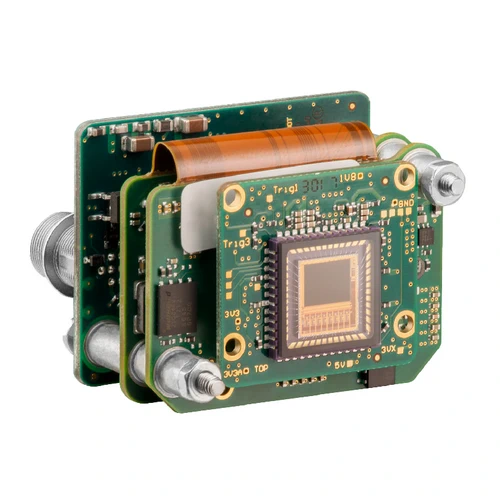
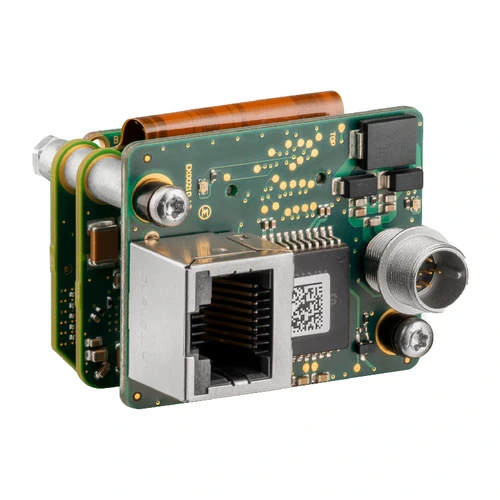
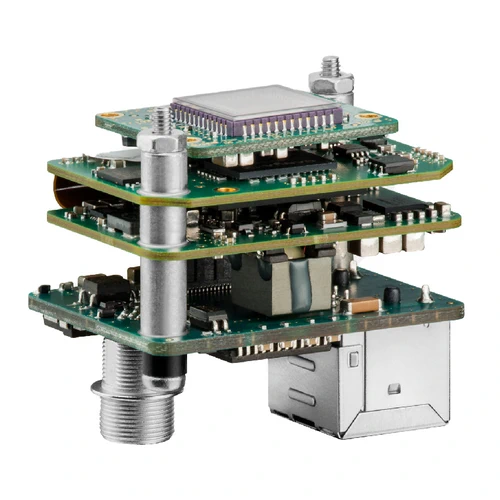
IDS GV-5282SE Rev.4.2 5MP global shutter GigE camera for distortion-free high-speed inspection, precise trigger sync, and reliable measurements.
IDS GV-5282SE is a 5MP global shutter GigE board-level camera designed to eliminate motion distortion when inspecting fast-moving parts. Built around a 2/3″ sensor resolution of 2464 × 2056, it delivers sharp edges and reliable feature geometry for measurement and defect detection. Hardware triggering and flexible image controls help keep timing consistent in automation cells, while the compact board-level format supports space-limited embedded designs and multi-camera layouts. If your current setup suffers from blur, skew, or unstable results at speed, this model targets that exact problem with distortion-free capture and deterministic synchronization.
IDS GV-5282SE combines global-shutter imaging with GigE connectivity to make industrial integration predictable and scalable. In practice, it improves inspection stability by synchronizing exposure to conveyors, actuators, and strobed lighting—reducing false rejects on shiny surfaces and increasing repeatability for gauging tasks. ROI and bandwidth control can prioritize critical regions to maintain throughput, while high bit depth supports cleaner contrast separation for subtle scratches, print defects, or edge transitions. Power options such as PoE or standard industrial supply simplify wiring in distributed cabinets, and the board-level design helps OEMs build compact, serviceable vision modules.
Choose the IDS GV-5282SE when your vision system must “tell the truth” at speed. Its global shutter freezes motion so edges stay straight, measurements stay stable, and defects don’t hide inside blur. With GigE, trigger control, and a compact board-level build, it fits both production lines and OEM machines that demand clean images, precise timing, and integration that does not become a long-term maintenance burden.
The IDS GV-5282SE solves the common failure of high-speed inspection: unreliable images caused by motion distortion, timing drift, and inconsistent lighting capture. When parts move quickly or vibration is unavoidable, rolling shutter cameras can skew geometry and smear fine defects. This model locks exposure to your trigger and freezes movement, producing repeatable images that improve pass/fail confidence and measurement accuracy.
| Feature | Details | Benefit |
|---|---|---|
| Sensor Brand & Model | Sony IMX264 (Color: IMX264LQR-C / Mono: IMX264LLR-C) | Proven sensor platform for stable, repeatable machine-vision imaging |
| Interface | GigE (RJ45) | Long cable runs and simple network-based integration for industrial systems |
| Interface Speed | GigE class Ethernet | Practical bandwidth for 5 MP inspection with ROI/bandwidth controls |
| Resolution (H×V) | 2464 × 2056 | High-detail imaging for defect detection and precise measurement |
| Optical Area (H×V) | 8.473 mm × 7.086 mm | Efficient sensor coverage for common industrial optics and FOV targets |
| Optical Format | 2/3″ (Diagonal 11.05 mm) | Broad lens compatibility and strong light collection for stable contrast |
| Lens Mount | No mount (board-level) | Maximum mechanical flexibility for OEM integration and custom housings |
| Pixel Size | 3.45 µm | Balanced sensitivity and detail for mixed lighting and fast exposure needs |
| Shutter | Global shutter | Eliminates motion skew/blur for moving parts and strobed lighting setups |
| Frame Rate @ Max. Resolution | 24 fps (freerun / continuous trigger), up to 25 fps (max trigger) | Maintains throughput in inspection lines while preserving full resolution |
| Exposure Time | 0.033 ms to 2000 ms (long exposure up to 90000 ms) | Covers “freeze motion” capture through low-light, longer integration scenarios |
| Image Memory | 128 MB | Improves operational stability for bursty traffic and real-time acquisition |
| Trigger & Flash I/O | Opto-isolated trigger input + opto-isolated flash output; GPIO via 8-pin Hirose (HR25-7TR-8PA(73)) | Deterministic timing and clean synchronization with strobes/encoders/PLCs |
| Power Supply | 12–24 V DC or PoE | Flexible powering for cabinets, distributed nodes, or PoE infrastructure |
| Power Consumption | 1.7 W to 2.9 W | Lower thermal load for compact enclosures and embedded vision modules |
| Software Tools | IDS peak; supports ROI, IP settings, bandwidth management, PTP, chunks, firmware update | Faster commissioning, easier multi-camera timing, and maintainable lifecycle |
| Image Processing / Controls | Auto exposure/gain; gamma; LUT; mirror/flip; decimation & binning (FPGA); sensor decimation 2×2 | Optimizes image quality and data rate without redesigning mechanics or optics |
| Pixel Formats | Color: Mono8, BayerRG (8/10/12 + packed), RGB/BGR (8 + packed 10) Mono: Mono8/10/12 (+ packed) | Smooth integration into common vision libraries and image-processing pipelines |
| Environmental Tolerance | Operating: 0–55 °C; Storage: -20–60 °C; Humidity: 20–80% (non-condensing) | Suitable for typical industrial cabinets and controlled production environments |
| Housing Protection | IP code: not specified (open board) | Best for protected OEM builds where the enclosure defines protection level |
| Size & Weight | 31.5 × 40.0 × 30.0 mm; 36 g | Easy to fit into space-limited machines and multi-camera arrays |
Download IDS GV-5282SE-C Rev.4.2 (AB12159) Datasheet
Download IDS GV-5282SE-M Rev.4.2 (AB12160) Datasheet
Download IDS GV-5282SE Rev.4.2 Technical Drawing
On fast conveyors, vibration and part rotation can smear fine scratches, burrs, or edge chips—creating unstable reject rates. A Sony IMX264 global-shutter camera freezes motion so edges remain geometrically correct for gauging and defect classification. In practice, integrators strobe high-intensity lighting and trigger exposure from an encoder so each image is captured at the same mechanical position, cycle after cycle. When throughput is tight, the system applies ROI to read only the critical inspection area, keeping data bandwidth manageable without sacrificing detection performance.
Pick-and-place lines fail when vision cannot reliably localize parts at speed—especially with glossy trays, moving films, or vibrating infeeds. IMX264-based cameras are commonly used in robot guidance because global shutter preserves shape during rapid motion, improving centroid and pose estimation. A practical setup uses a trigger tied to robot timing plus short exposure and controlled illumination to reduce specular glare. If multiple SKUs share a station, ROI and parameter recipes let you switch between regions and inspection rules quickly, keeping cycle time stable while maintaining placement accuracy.
Small fonts, dense barcodes, and QR codes become unreadable when images blur or when reflections wash out contrast. A 5MP IMX264 global-shutter sensor helps preserve crisp module edges on moving packaging, enabling grading of print quality, contrast, and quiet-zone compliance. In real lines, engineers synchronize capture with strobed lighting to “lock” exposure and avoid motion smear, then tune gamma/LUT and gain to keep black/white separation consistent across varying materials. ROI keeps processing fast by focusing only on the label zone even when the full frame is larger.
Outdoor scenes combine speed, low light, and high dynamic highlights (headlights, reflections), which often breaks recognition when motion distortion occurs. IMX264 global shutter capture prevents skewed characters and maintains accurate geometry for plate or vehicle feature extraction. Integrators commonly pair synchronized IR illumination with precise triggering to improve night performance while keeping exposure short to reduce smear. When processing must be real-time, ROI restricts acquisition to the plate or lane zone, lowering bandwidth and compute load while improving algorithm consistency across day/night transitions.
Measurement pipelines demand repeatability: a few pixels of motion blur can translate into failed tolerances or unstable calibration. IMX264’s global shutter supports distortion-free capture needed for edge fitting, hole/slot measurement, and alignment checks on moving stages. In structured-light or multi-view setups, consistent timing is critical; triggered acquisition and deterministic synchronization reduce frame-to-frame drift, improving triangulation stability. Engineers often trade full-frame bandwidth for higher reliability by using ROI around features of interest, allowing faster loop times while keeping measurement noise low in real production environments.
C-Mount Industrial Lenses – Optimized for 2/3″ sensors (IMX264 class)
GigE PoE Switch / PoE Injector – Single-cable power + data for cleaner installations
Industrial Shielded GigE Ethernet Cables – Stable streaming in high-EMI factory environments
Trigger & Flash I/O Cable (8-pin Hirose compatible) – Deterministic trigger and strobe synchronization
GigE Network Interface Card (Intel-based recommended) – More consistent throughput for vision streaming
Mounting & Enclosure Hardware (OEM integration) – Protects board-level camera and simplifies serviceability
GV-5281SE Rev.4.2 Series – 5 MP Sony IMX264 Global Shutter GigE (with C-mount holder option)
GV-5280SE Rev.4.2 Series – 5 MP Sony IMX264 Global Shutter GigE (alternate board-level variant)
GV-5282SE Rev.4.2 Series – 5 MP Sony IMX264 Global Shutter GigE (board-level, max mechanical flexibility)
As an authorized distributor of IDS products, we offer certified expertise and technical support to ensure you get the most out of your GV-5282SE Rev.4.2 camera. We stand by the quality of our products and provide comprehensive warranty services. Our team can also assist with special services like custom integration and creating pre-configured kits tailored to your specific needs.